




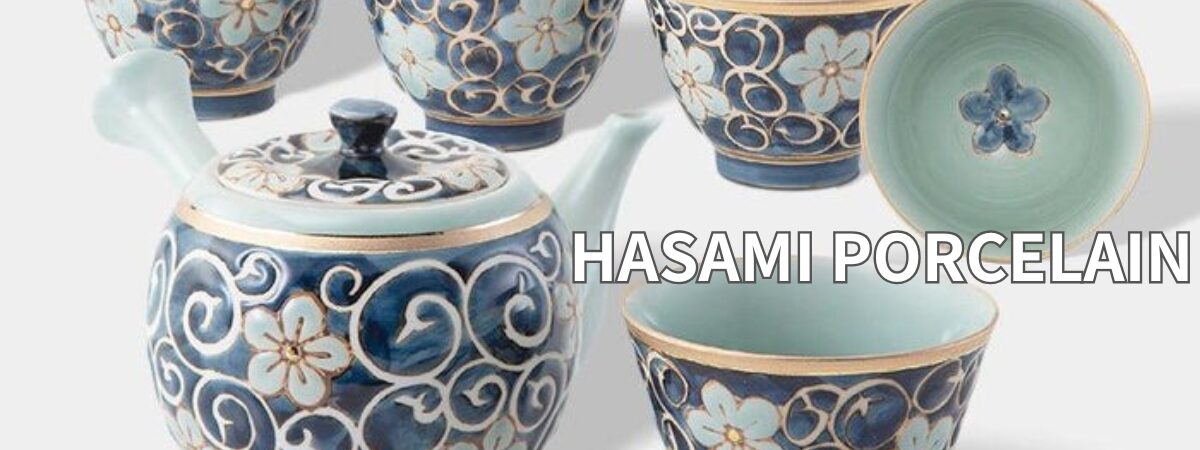
- What is the appeal of Hasami ware? Its history, characteristics, and designs gaining international attention
- What is Hasami Ware? Its Charm and Birthplace
- The History and Evolution of Hasami Ware
- Characteristics and Diverse Designs of Hasami Ware
- Why Hasami Ware is Stylish and Popular
- Kilns Supporting the Division of Labor in Hasami Ware
- The appeal of Hasami ware, attracting attention even from overseas
- What is Hasami Ware? History, Characteristics, and Popular Kilns from Overseas
What is the appeal of Hasami ware? Its history, characteristics, and designs gaining international attention
- What is Hasami Ware? Its Charm and Birthplace
- The History and Evolution of Hasami Ware
- Characteristics and Diverse Designs of Hasami Ware
- Why Hasami Ware is Stylish and Popular
- Kilns Supporting Hasami Ware’s “Division of Labor System”
- The Appeal of Hasami Ware, Gaining Attention Overseas
- What is Hasami Ware? History, Characteristics, and Popular Kilns Overseas
What is Hasami Ware? Its Charm and Birthplace
Hasami ware is the collective name for ceramics produced near Hasami Town, located in the central northern part of Nagasaki Prefecture. This area borders Arita Town in Saga Prefecture, famous for its pottery, and has long been known as a region thriving in ceramic production. With a history spanning over 400 years, Hasami ware remains deeply rooted in our daily lives, currently accounting for approximately 16% of Japan’s daily tableware market share.
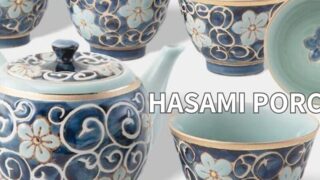
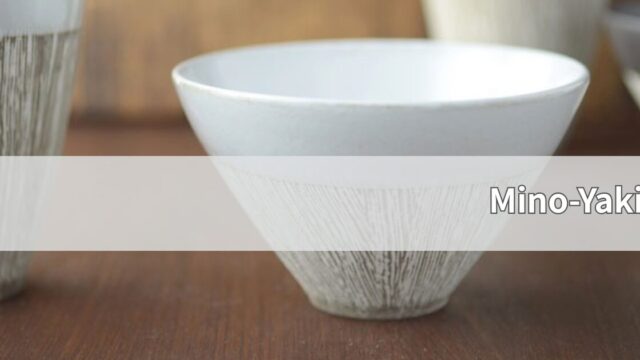
A major appeal of Hasami ware lies in its practicality and diverse designs. The beauty of white porcelain and the delicate indigo-blue underglaze decoration technique are one of the representative features of Hasami ware. However, Hasami ware has never been confined to a specific style, constantly incorporating new designs to suit the times and people’s needs. Consequently, it is said that “having no defining characteristic is its defining characteristic.” A remarkably wide range of pieces are produced, spanning retro atmospheres, modern designs, and colorful creations.
Raw Materials and Production Areas of Hasami Ware
The primary raw material for Hasami ware is porcelain stone mined from the Amakusa Peninsula in Kumamoto Prefecture, which is also used in Arita ware. Hasami Town has a basin-like topography, with a central plain surrounded by low mountains. Porcelain stone, the raw material for porcelain, is produced especially from the mountains in the southeastern part. Although it is a small town with a total area of about 56 square kilometers and a population of about 15,000, it is said that a full 20 to 30 percent of its residents are engaged in work related to pottery.
The History and Evolution of Hasami Ware
The history of Hasami ware dates back to the 1590s. The invasions of Korea by Toyotomi Hideyoshi, known as the Bunroku-Keicho Campaigns, prompted daimyo from various regions to bring back numerous potters from Korea.
The Ōmura domain was no exception. Together with potters brought back from Korea, they built terraced climbing kilns in three locations within Hasami Village: Hatano-hara, Furisara-ya, and Yamanita. Pottery production began there in 1599, marking the start of Hasami ware.
Initially, production focused on glazed pottery. However, the discovery of porcelain stone within the village led to successful porcelain firing between 1610 and the 1620s, marking a full-scale shift to porcelain production.
By the 1630s, with the interruption of Chinese porcelain exports due to civil unrest, Hizen ceramics began exporting worldwide, propelling Hasami into becoming a major porcelain production center.
“Kurawanka Bowl” and “Kompura Bottle”
Around 1690, as civil unrest in China subsided and overseas exports declined, Hasami ware shifted its focus to mass-producing everyday tableware for the domestic market. It was during this period that the “Kurawanka bowl” was born, bringing a major transformation to the food culture of Edo commoners. Inexpensive, sturdy, and easy to use, this bowl earned its name from its use on the thirty-koku boats plying the Yodo River to sell food and sake, becoming a nationwide hit.
Also during this period, “kompura bottles” were produced for exporting sake and soy sauce. These bottles were actively exported from Dejima in Nagasaki by the Dutch East India Company to Southeast Asia and the Netherlands, playing a vital role in connecting Hasami with overseas markets. They were beloved worldwide, with anecdotes suggesting even the Russian literary giant Tolstoy was a fan.
Development and Brand Establishment Since the Meiji Era
After the Meiji period, Hasami ware began to be produced by organized ceramic companies, leading to significant changes in shaping, decoration, and kiln fuel. During the period of rapid economic growth from the 1950s to the 1970s, it achieved dramatic development, aided by nationwide distribution reforms.
Long distributed as part of Arita ware, the emergence of origin mislabeling issues around the year 2000 prompted demands for strict production area labeling as “Hasami ware.” Seizing this opportunity, Hasami ware broke free from its traditional history, actively embracing diverse colors and modern designs aligned with contemporary trends, thereby establishing its own distinct brand identity.
Characteristics and Diverse Designs of Hasami Ware
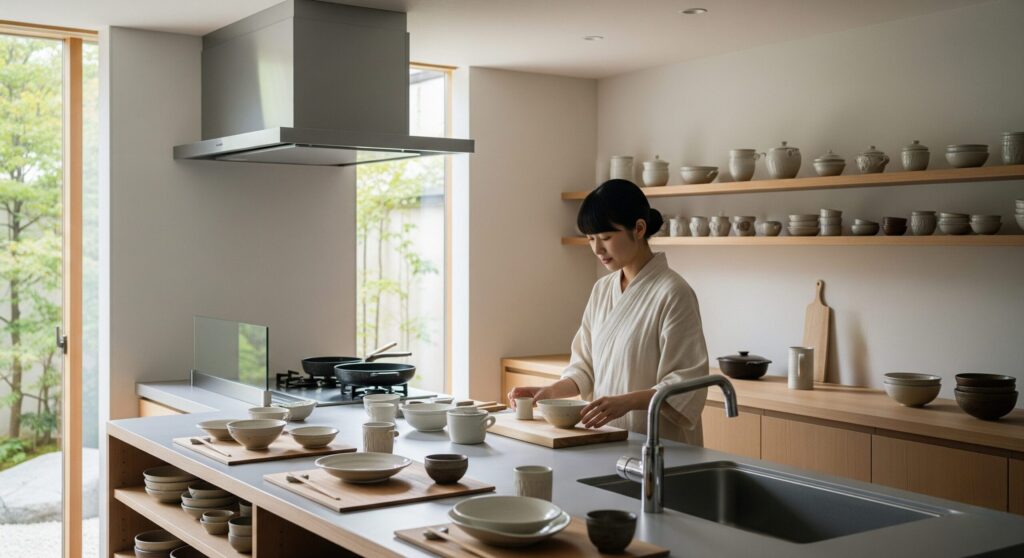
The defining characteristics of Hasami ware lie in its high practicality and diverse designs. The translucent beauty of its white porcelain and the delicate underglaze blue decoration technique represent the traditional appeal of Hasami ware. However, Hasami ware does not merely cling to tradition; it has consistently challenged itself to create new pieces, developing unique designs that align with people’s lifestyles, trends, and the spirit of the times.
Durable and easy-to-use everyday tableware
Hasami ware primarily features porcelain made with powdered porcelain stone, giving it minimal water absorption and resistance to staining. It is also durable and break-resistant, with many pieces dishwasher and microwave safe, making it exceptionally well-suited for everyday tableware. Its easy maintenance and high durability allow for long-term use, adding to its appeal.
Reasonable prices and high quality
Hasami ware is characterized as a high-quality traditional craft that is also sold at an affordable price. This is due to the established “division of labor system” where different artisans handle each step.
Rather than one person making an entire piece, specialized artisans handle each process—mold making, clay preparation, painting, firing—allowing knowledge and techniques to be concentrated. This enables the mass production of high-quality products. Consequently, it has become widely popular as tableware that anyone can easily use daily.
Richness of design
Hasami ware, often described as “characterized by having no distinct characteristics,” has always produced diverse designs that adapt to the times precisely because it lacks fixed molds. In recent years, an exceptionally wide variety has emerged, including Scandinavian-inspired designs, colorful pieces, and items featuring simple color palettes like white and gray. Many highly design-oriented products by young designers are expanding the fan base of Hasami ware. For example, Hasami ware from the DRESS brand is acclaimed for its full application of 14 traditional Japanese glaze colors, which enhance the appearance of food and add vibrant color to the dining table.
Why Hasami Ware is Stylish and Popular
The reason Hasami ware has gained attention as “stylish” in recent years lies in its balance of design and practicality. A major factor is the abundant availability of modern, stylish designs that complement contemporary lifestyles, complementing its traditional image.
Design tailored to modern needs
In recent years, Hasami ware has focused on user-centered design, creating pieces that emphasize ease of handling and lightness through universal design, prioritize storage efficiency, and offer series tailored for smaller households. Production of cookware suitable for direct flame and microwave cooking has also flourished, with high functionality being another key reason for its popularity.
Furthermore, designs like the thick, rugged mugs from Maruhiro’s new brand “HASAMI” – a stark contrast to the prevailing thin, delicate aesthetic of the time – became nationwide hits. Their availability in apparel shops and variety stores significantly boosted both sales and recognition for Hasami ware. The emergence of such new brands is invigorating the entire production area, enhancing its reputation and increasing sales.
Kilns Supporting the Division of Labor in Hasami Ware
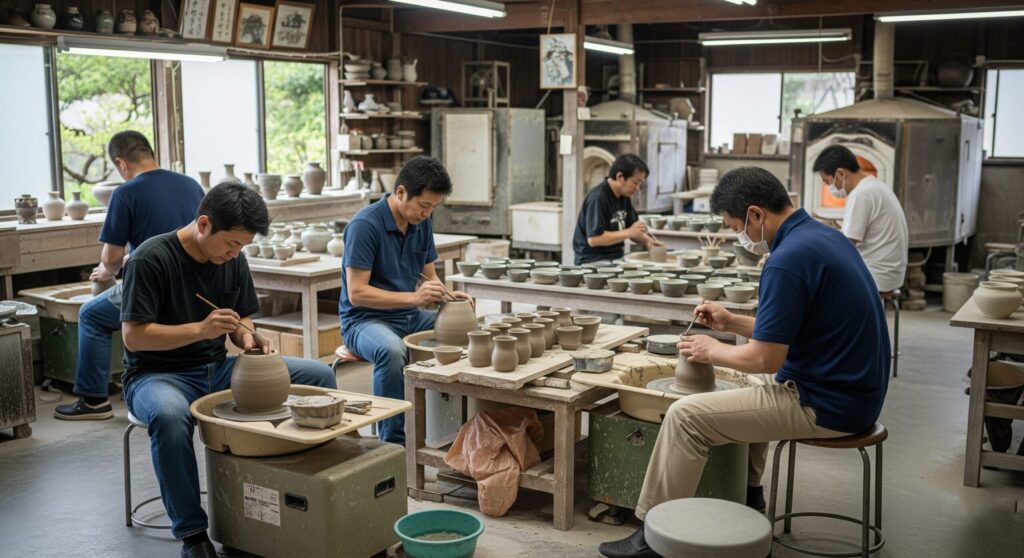
The high quality and mass production of Hasami ware are made possible by its unique “division of labor system.” This system enhances the expertise of each process, contributing to the overall improvement of Hasami ware.
Division of Labor System
The production of Hasami ware is divided into the following processes:
| process | role |
|---|---|
| Mold maker | We produce plaster molds for ceramics. |
| Fabric Store | Shape the dough from the mold. |
| Pottery Shop | We supply soil to the fabric store. |
| pottery studio | The fabric is fired to complete the final product. |
| Overglaze Painter | We produce decals for ceramics. |
| Producer wholesaler | We consolidate orders and arrange shipping and other logistics. |
In this way, each workshop specializing in its particular task fosters skilled techniques and speed, enabling the efficient mass production of well-balanced products. This division of labor was an essential factor in Hasami ware becoming widely adopted as everyday tableware for the common people.
However, in recent years, some kilns have emerged that transcend the division of labor framework, undertaking all processes themselves. For example, a workshop run by a former chef husband and his German wife, dissatisfied with mass-produced molded vessels, established a unique style where the couple handles every step themselves to deliver handmade original pieces. Such new endeavors are further expanding the diversity of Hasami ware.
The appeal of Hasami ware, attracting attention even from overseas
Hasami ware has garnered significant attention overseas in recent years for its quality and design. Brands like HASAMI PORCELAIN, whose designs align with contemporary lifestyles, are frequently used in cafes across America and Europe, earning international acclaim.
Design Across Borders
HASAMI PORCELAIN was born as “tableware that innovates heritage with a contemporary concept,” under the direction of Los Angeles-based designer Takuho Shinomoto. Inspired by the traditional Japanese lacquerware “jūbako,” it features a functional design that stacks for storage and a unique material feel that pursues the best qualities of both pottery and porcelain. Its three color options—Natural, Black, and Clear—are also praised for their compatibility with international interior design.
Indeed, there’s an anecdote about HASAMI PORCELAIN gaining popularity in Japan after being spotted in overseas cafes, essentially being re-imported. This illustrates how Hasami ware transcends borders. Many foreign customers seem familiar with HASAMI PORCELAIN from the start, suggesting Hasami ware is now integrated not only into contemporary Japanese dining but also into tables worldwide.
What is Hasami Ware? History, Characteristics, and Popular Kilns from Overseas
- Hasami ware is pottery produced in Hasami Town, Nagasaki Prefecture.
- A traditional Japanese craft with over 400 years of history
- It holds a high market share nationwide as everyday tableware.
- There was a time when it circulated as Arita ware.
- The beauty of white porcelain and indigo-blue underglaze decoration are its traditional characteristics.
- Its designs are so diverse it’s said to have “no defining feature as its defining feature.”
- It constantly incorporates new designs to suit the times and needs.
- It is durable, stain-resistant, and practical, being dishwasher and microwave safe.
- A division of labor system achieves high quality and reasonable prices.
- During the Edo period, “Kurawanka bowls” became commonplace on commoners’ tables
- “Komura bottles” for overseas export were also produced
- In recent years, brands like “HASAMI” have gained popularity for their stylish designs
- Many products incorporate universal design and storage efficiency
- Used in cafes overseas, it enjoys high international acclaim
- The annual “Hasami Pottery Festival” attracts numerous visitors
Comment